Why invest in Human-First software when Agentic-First software cuts labor, reduces data-entry errors, speeds task completion, shortens training, lowers the skill bar, and costs less to build, buy, and maintain?
That question becomes practical the moment a business puts AI agents to work at the product level. It points to a design shift most software teams have not yet recognized.
The next generation of applications will not be designed around screens and forms. They will be designed around agent interactions, with a user interface appearing only where a human needs to make a decision.
The Assumption That No Longer Holds
Every enterprise application in use today was built on a single assumption: a human being sits in front of a screen and enters information. The form is the unit of interaction. The dashboard is the unit of consumption. That assumption has shaped tens of billions in enterprise software spending, and it is increasingly mismatched with how work actually happens inside organizations that have deployed agentic systems.
NNGroup's State of UX 2026 report identifies trust as the defining design challenge for AI-mediated experiences. Users who have been burned by premature AI features resist adopting new ones. But users who have worked alongside reliable agents for six months develop a different expectation of what software should do. They expect the agent to handle the data entry. They expect to hold positions of review and approval, not origination.
What Agentic-First Software Looks Like
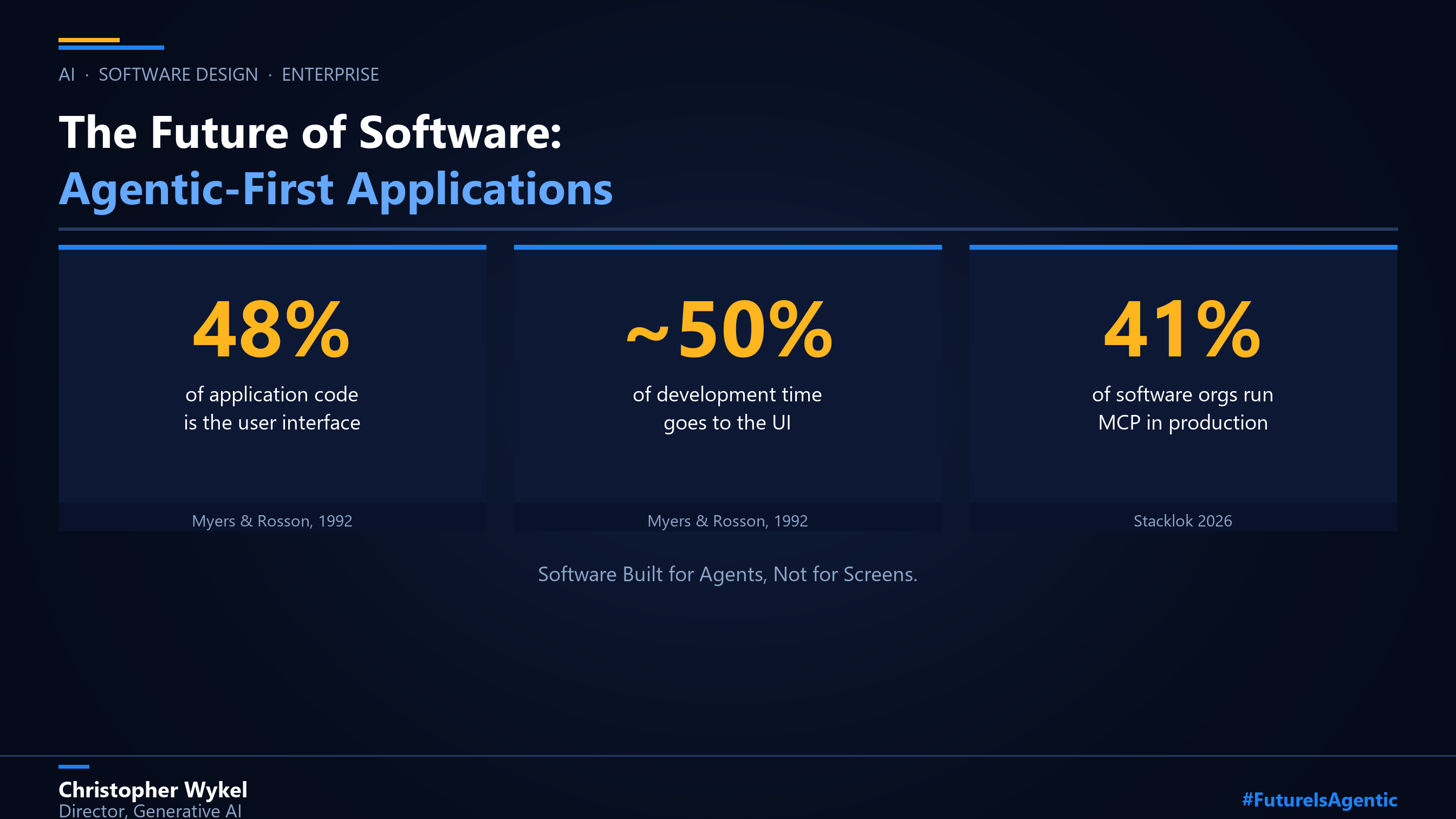
The pattern is already visible in production MCP deployments: by 2026, 41 percent of software organizations were running MCP servers in limited or broad production. A few relatable cases show the same principle from different angles.
Start with a sales example, because most people will recognize it at once. The rep tells the agent: read today's email, find any new customer contacts, log the calls in Salesforce, draft a follow-up to each one for me to review, and if a customer placed an order, enter it into the ERP but hold it for my approval. The agent works across the inbox, the CRM, and the ERP, and stops wherever judgment begins. The rep spends the recovered hour selling instead of typing, and every entry still passes under a human eye before it counts.
HR onboarding shows the same shape from a different starting point. The agent queries Workday for the new hire record, creates accounts in Okta, provisions Slack channels, and sends the welcome email. The person reviews the onboarding checklist and authorizes the go-live. Work that used to take three hours across five systems is handled in seconds, and the human's job becomes judgment, not data entry.
Financial compliance monitoring moves the pattern into oversight. The agent reads transaction data, flags anomalies against known patterns, and drafts preliminary reports. The compliance officer reviews the flag, adds context, and either files or escalates. The agent does the reading; the human does the deciding.
IT incident response runs it under time pressure. The agent reads PagerDuty alerts, checks the ticket system for similar past incidents, queries the runbooks, and executes the first remediation step on its own. The engineer is told what was done, can roll it back, and handles anything outside the known pattern. The agent triages; the human escalates.
Just four example cases, but the list runs about as long as the roster of systems a company owns: marketing intelligence, conversational analytics over the CRM, knowledge search across internal wikis and codebases, and on down the entire app stack. Businesses are already trying to accomplish this with MCP connections to human-centric applications, but the landscape is starting to shift. Consider AgentMail, an email inbox built solely for AI agents to use. Just one example among many, with a tidal wave of others on the horizon.
The UI-Minimal Design Principle
The common thread across these patterns is that the output moves into the conversation where humans need it, whether a chat thread, a notification, or a briefing, rather than requiring a visit to a separate application. The input side follows a parallel pattern: AI-prefilled forms surfaced to the user with an edit button before submission. Human-in-the-loop by design, not by default.
The form stays. What changes is who fills it.
The agent fills it from your data. You confirm it. That shift from origination to confirmation is a different interaction model, and it carries implications for how software is designed, sold, and priced.
The Economics Underneath the Design Shift
The design shift is interesting on its own. What makes it consequential is what it does to the cost of building and acquiring software.
Consider an incumbent enterprise system, an ERP platform that a large company runs millions of dollars of operations through. A great deal of what that platform costs to build, and to license, is the interface: the screens, the field validation, the workflow logic that all exists to make sure a person enters the right data in the right place in the right format. For form-and-dashboard software, the interface is not incidental to the product. It is most of the product. This is not a new measurement. Since the early 1990s, studies have put roughly 48 percent of application code and half of development time in the user-interface layer. What changes with Agentic-First design is that the layer no longer has to exist.
Now picture a competitor building the same underlying system for a different operator. The data model is the same. The business logic is the same. But in place of an interface designed to guide people, the inputs are defined as agent-facing tools with hard-coded requirements, so an agent cannot complete an action without supplying the correct variables. Software built without the UI layer can be built for a fraction of the cost, because the layer that consumed most of the engineering effort is simply gone.
That cost difference does not stay with the vendor. It compounds in three directions. Building and maintaining the product costs far less. Licensing it costs the buyer less in turn. And the buyer's own operating cost falls, because staff no longer spend their days keying data into screens; their agents do that, using MCP to talk to the new system directly. The training burden falls with it. An employee no longer has to learn how to fill in the work-order screen, only how to ask the agent to file the work order. The skill of operating the software moves into the agent, while the person supplies intent and judgment. Migration does not interrupt the workday. Employees keep talking their way through their tasks, and the agent handles the data entry against the new system instead of the old one.
The result is an incumbent carrying the full cost of a UI-first architecture, competing against a challenger whose architecture never needed one. Multiply that across every system a company runs, from finance to HR to procurement, and the savings stop being a line item and become a reason to replace the stack. The transformation is not a better interface, but the removal of the reason the interface existed.
What This Means for Software Strategy
For product leaders, the implication is uncomfortable: the application as a destination is becoming optional. If an agent can complete the primary workflow through MCP and A2A interfaces and deliver the result into the user's existing conversation thread, whether anyone ever opens the application becomes a fair question. Designing for that reality means agent-completable workflows, output delivered into the conversation, and human review as the bottleneck instead of data entry. It also means a structural cost advantage over anyone still carrying the legacy form-and-dashboard model.
For buyers evaluating enterprise software, the relevant question shifts from what features the application has to what workflows the agent can complete. The application with the best API for agentic access may win deals that the one with the best user interface cannot touch. That is a fundamental change in how software value is evaluated.
User interfaces are not going away. People will always need a screen for the judgment calls and the exceptions that carry real weight. What is changing is the ratio: how much of the work an agent completes before a human ever looks at it, and where that review happens.
The software development question is no longer which features to add for the user. It is which workflows an AI agent can handle, and when human-in-the-loop feedback is needed, which channels deliver the output. Customers will stop logging into software directly and let their agents complete the work instead. The shift in the software marketplace will be significant, because every party stands to gain. Developers can build applications faster for AI and with AI than they ever could for humans and with humans. That alone means they can undercut the incumbents on price and still remain highly profitable. Customers gain productivity, cut costs and mistakes, and watch the barriers to business-to-business integration grow slimmer than ever. The stage is set for the next dot-com boom, the next app-store gold rush. The wave of Agentic-First applications is nearly here. Is your business ready?
Sources
- NNGroup, State of UX 2026. Trust as the defining design challenge for AI-mediated experiences.
- MCP production use cases: sales workflow automation, HR onboarding, financial compliance, IT incident response, marketing intelligence, conversational CRM analytics, internal knowledge search. Documented patterns from enterprise MCP deployments.
- Brad A. Myers and Mary Beth Rosson, "Survey on User Interface Programming," CHI 1992. ~48% of application code and ~50% of development time devoted to the user interface. dl.acm.org
- AgentMail, email inbox API built specifically for AI agents. Y Combinator-backed; raised $6M seed led by General Catalyst, March 2026. agentmail.to | TechCrunch
- Stacklok 2026 Software Report. 41% of software organizations have MCP servers in limited or broad production.