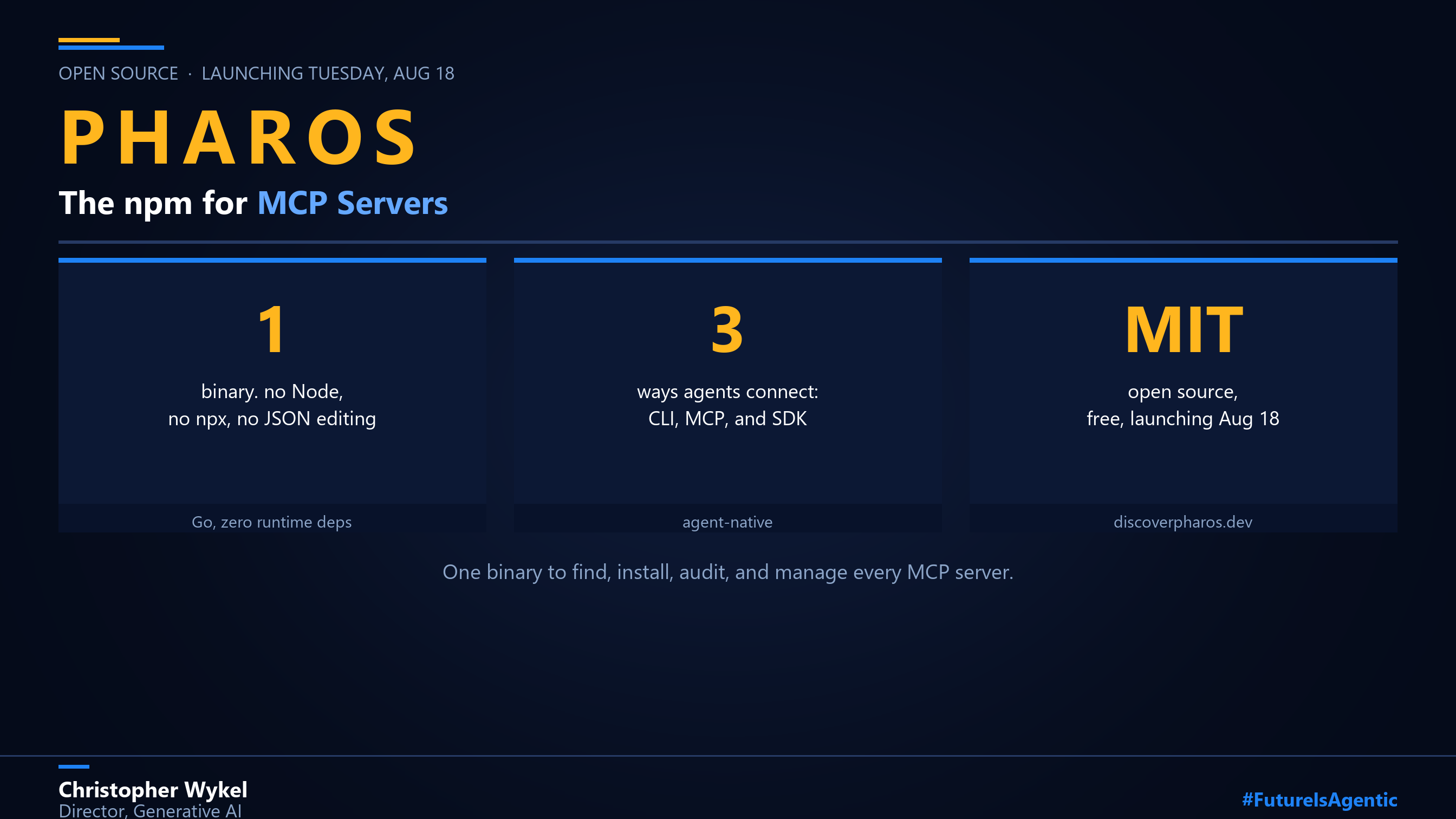
PHAROS is more than an MCP registry. It is an open-source MCP management CLI and an open-source agent-integration package for MCP servers. One binary lets you find, download, install, configure, and maintain your MCP servers from one place. And any AI agent can use it too: through the CLI directly, over MCP, or through native integration.
Instead of thirty minutes of manual setup, it is one command. Want to see how much memory each MCP server is using and which are running? One command. Want to shut one down or remove it? One command. PHAROS is your all-in-one MCP management solution.
Why I Built It
Connecting AI to external systems has been part of my work for about four years. At first I was the bridge myself, hand-crafting tools to third-party services. Then MCP changed the process: vendors built the bridges. Less painful, but still far from easy.
Every time I set up a new agent, I went through the same manual process: find the MCP server I needed, figure out its dependencies, install it, configure it, repeat for the next one. It felt like managing Python packages before pip, or JavaScript before npm. Valuable time every week, lost to setup that should have been automated.
So I built PHAROS.
The Problem PHAROS Solves
The MCP ecosystem has a discovery and distribution problem. The protocol itself is well-designed: Anthropic and the Linux Foundation did the hard work on the standard. But the tooling around it has not caught up.
Right now, finding the right MCP server means browsing GitHub repos, reading READMEs, checking compatibility, and manually configuring each one. Publishing a server means writing documentation, packaging it, and hoping people find it. There is no dependency management, so if your server needs another server to function, the user has to figure that out themselves.
This is the same gap that npm filled for JavaScript, pip for Python, and Cargo for Rust. The pattern is proven: a standard emerges, adoption explodes, and the infrastructure to manage it becomes essential.
MCP is at that inflection point right now.
What PHAROS Does
The install is a single curl command. The CLI searches the registry, installs servers with recursive dependency resolution (if one MCP server depends on another, PHAROS resolves and installs both), and manages the lifecycle of every server on your machine. It writes directly to Claude Desktop and Cursor configuration files, and supports a generic adapter for any MCP client that uses the standard mcp.json format. No manual JSON editing.
I have written before about how MCP is disintermediating traditional search and discovery.
The Security Dimension
The security angle matters more than people realize. MCP servers run with the privileges of the agent that launches them. A compromised server can read your filesystem, access your API keys, and execute arbitrary code. Installing one should not be a trust-the-process exercise.
PHAROS includes an audit command that scans installed MCP servers against the Open Source Vulnerabilities (OSV) database, which aggregates security advisories from across the open-source ecosystem. It flags known vulnerabilities in installed packages, reports affected versions, and shows you where the fix lives. The same model npm audit and pip-audit use, applied to MCP.
There is also a supply-chain dimension. Without a package manager, there is no audit trail. No version pinning. No lockfile. PHAROS generates a lockfile on every install, so you know exactly what is running and can reproduce the setup on another machine.
In a world where MCP servers can read files, execute commands, and call APIs, that is not a convenience feature. It is infrastructure.
Agent-Native by Design
What sets PHAROS apart is that it is built for agents as well as humans. The Discovery SDK exposes the registry as an MCP server itself, so any AI agent can search for, evaluate, and connect to MCP servers programmatically. An agent that needs filesystem access can find the right server, install it, configure itself, and start using it, with little more than the user's approval.
This is not a roadmap item. The SDK ships in Python and TypeScript, supports multiple transports (stdio, SSE, streamable HTTP), and includes an approval system so the human stays in the loop on every new connection. Agents get autonomy; humans get control.
What's Next
PHAROS launches next Tuesday. The CLI is built in Go: one binary, no runtime dependencies, installs in seconds. The registry API is live. The web interface is at discoverpharos.dev. Both the CLI and the SDK will be open-source under MIT license.
If you are building with MCP servers or thinking about agent infrastructure, check out the link. I would value your feedback.
The MCP standard gave agents a common language. PHAROS gives them a package manager.
Sources
- Model Context Protocol introduced by Anthropic, November 2024. modelcontextprotocol.io | anthropic.com
- MCP donated to the Linux Foundation's Agentic AI Foundation, December 9, 2025. anthropic.com | blog.modelcontextprotocol.io
- OSV - Open Source Vulnerabilities database (Google / OpenSSF). Aggregates advisories from 30+ ecosystems in a machine-readable schema. osv.dev | github.com/google/osv.dev
- Precedent tooling PHAROS mirrors for MCP: npm audit (npm) and pip-audit (PyPA).
- PHAROS product claims: one Go binary; recursive dependency resolution; OSV-based audit; lockfile on every install; Discovery SDK in Python + TypeScript with stdio / SSE / streamable-HTTP transports; MIT license; writes configs for Claude Desktop, Cursor, and any client using the standard mcp.json format. Sources: github.com/Wpnx330/pharos-cli, github.com/Wpnx330/pharos-discovery, discoverpharos.dev