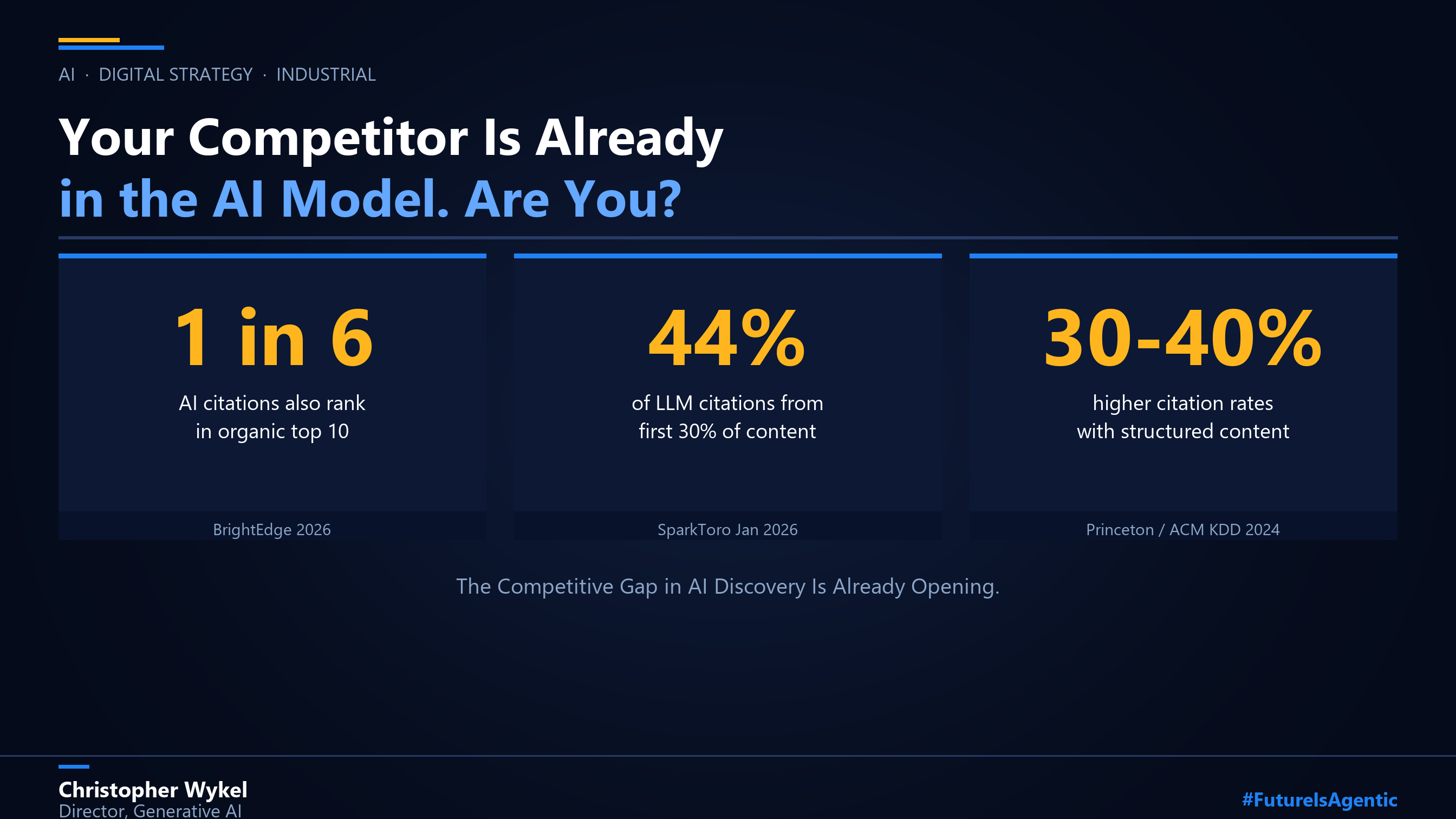
When an AI assistant recommends a vendor in your space, it is choosing between you and your competitors. Most businesses have done nothing to influence that choice.
Three Channels, Three Gaps
The discovery landscape now runs across three parallel channels. SEO, the traditional search game most businesses have been playing for two decades, is Channel 1: rank on Google, get a click-through. GEO, or Generative Engine Optimization, is Channel 2: the question is whether AI models name you when they answer your customers' questions. AEO, or Agentic Engine Optimization, is Channel 3: can AI agents access your products and services directly through structured interfaces, and are those interfaces discoverable in the tools your customers are already using?
Most businesses have a Channel 1 strategy. A growing number are starting to think about Channel 2. Almost none have built for Channel 3. The competitive gap is largest where the fewest businesses are paying attention. And in Channel 2, where this article focuses, the gap is already opening.
Competitive Asymmetry
Only one in six sources cited in AI Overviews also ranks in the organic top ten. Strong search rankings do not automatically translate to AI visibility. SEO and GEO operate on fundamentally different criteria, and the businesses that have figured this out are accumulating share in Channel 2 while competitors remain focused on Channel 1.
Princeton researchers studying AI citation patterns found that businesses using structured, authoritative content formats saw 30 to 40 percent higher citation rates in AI-generated responses (ACM KDD, 2024). SparkToro research from January 2026 found that 44 percent of all LLM citations come from the first 30 percent of a piece of content. The introduction matters disproportionately. A business that leads with a clear thesis and a data-backed claim is structurally more likely to be cited than one that buries its best material halfway down the page.
This is not a technology problem. It is a capital allocation problem.
The businesses that show up in AI answers have made a deliberate decision to be there, treating GEO as an investment category on par with any other customer acquisition spend.
What the Gap Looks Like in Practice
The businesses winning in Channel 2 share three patterns. They publish content that answers specific questions directly rather than optimizing for keyword density: AI systems consistently favor citable answers over search-engine-optimized prose. They maintain consistent entity information across the web, ensuring company name, product descriptions, and technical specifications read identically on their own site and across industry directories, marketplace listings, and partner pages. And they earn references from authoritative third-party sources that AI training pipelines can cite with confidence, recognizing that cross-domain consistency functions as a credibility signal for the model.
A business that has done these three things will appear in AI-generated answers about your category. The customer rarely sees both options side by side. They do not know that you ranked well on Google, or whether you appeared in AI-generated results at all. They see only who the AI named.
The uncomfortable truth is that running this test may surface a competitor's name instead of your own. The results are sometimes clarifying.
A Fast Way to Know Where You Stand
In a previous article, I recommended asking an AI assistant to recommend a vendor for the product or service your business provides. It is a fast and easy way to reveal where your business stands in Channel 2. If your company does not appear in the answer at all, refine the question to box it in a bit more. Repeat the process until you do show up. Now you know precisely where the gap is.
If you are lucky, competitors have not made meaningful progress yet either, and your products are still visible to customers by happenstance. That is not a sign to relax. It is a sign to act. Cement your market share now by letting competitors remain in Channel 1 while you build presence in the channels of today and tomorrow.
Channel 3 raises the ceiling further. When AI agents can query your business directly through a structured interface, rather than crawling and guessing, the quality of the answer improves and so does your position in it. That infrastructure is available now and is the logical next move once Channel 2 legibility is established.
The Question for Leadership
The businesses that show up legibly and authoritatively across all three channels will compound their share of wallet over the next several years. The ones that do not will continue investing in a discovery channel whose share of effective decision-making is contracting. The question for your team is straightforward: are you building customer visibility in all three channels as a competitive priority, or are you hoping it will sort itself out?
Sources
- BrightEdge, 2026. 1 in 6 AIO sources also ranks organic top 10. brightedge.com
- Princeton / ACM KDD 2024. GEO: Generative Engine Optimization. 30-40% higher citation rates. arxiv.org
- SparkToro, January 2026. 44% of LLM citations from first 30% of content. almcorp.com
- Seer Interactive, Sep 2025. AI Overviews drive 61% drop in organic CTR. seerinteractive.com
- Pew Research, Jul 2025. 58% of users see AI summaries in Google searches. pewresearch.org