The way customers find products and services is changing fast. Not long ago, someone searching for what you sell would type a query into Google, scan the summaries of the links that came back, and click through to the ones that grabbed their attention. That was the game, and most businesses built their entire discovery strategy around it.
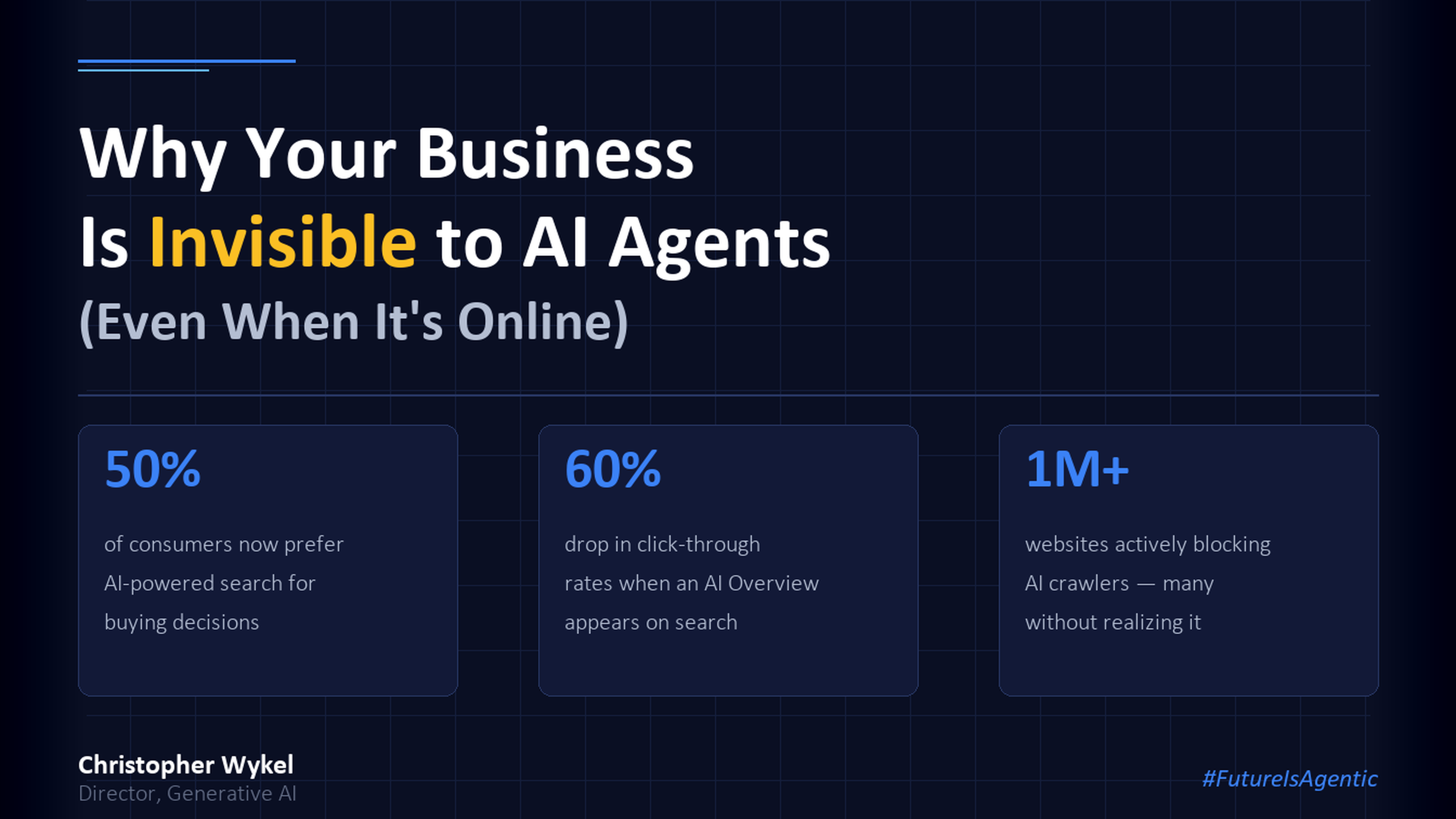
That game has shifted. According to McKinsey research published in 2025, nearly 50 percent of consumers now intentionally seek out AI-powered search, and 44 percent say it is their primary and preferred source for buying decisions, ranking above traditional search, brand websites, and review sites combined. Customers now read the AI-generated output at the top of search results, or they ask an AI agent directly. In either case, they did not personally encounter your content. They outsourced discovery to the AI.
That gap is widening. And most businesses, large and small, have no idea it exists.
If you are optimizing for Google search rankings or paying for ads, the numbers are stark. When Google surfaces an AI Overview on a search result page, click-through rates for the top organic position drop from roughly 27 percent to 11 percent. A 60 percent decline, on a query you were already winning. For brands not cited inside that AI Overview, the traffic simply does not arrive. You may already be invisible and not know it.
More alarming than these statistics and the trends they highlight: most businesses are actively, and in some cases intentionally, suppressing the bot traffic that could help them stay in front of their customers. If any of this is news to you, your business is probably one of them.
How AI Agents Actually Read the Web
When an AI agent goes looking for information, it is not browsing the way a person does. It is parsing structured content at scale, looking for signals that tell it what a page is about, how authoritative it is, and whether its contents are worth including in a response.
A 2025 study from ACL found that more than 90 percent of crawled web content is discarded as unsuitable for AI training. The filter was not traffic, or domain authority. It was structural legibility: could the system understand what the content was saying?
Most enterprise websites fail that test. Not because the content is bad, but because it was built for human eyes. JavaScript-rendered pages that load content dynamically are largely invisible to AI crawlers. Poorly structured HTML gives no signal about what matters. Marketing copy written to feel compelling does not parse well when a machine is trying to extract a product specification or a service offering.
Your website might look excellent. To an AI agent, it may not exist.
From SEO to AEO: The Rules Just Changed
Search Engine Optimization grew out of the need to show up well in indexes like Google, Yahoo, and Bing. Ranking well on Google's index proved more valuable for customer acquisition than the others, and so Google's requirements for ranking high became effectively enforceable industry standards. For two decades, SEO became the primary strategy for product discovery in most businesses.
Now the sands are shifting, and at an accelerating rate. Google's own AI overview features now appear on nearly half of all searches, and when they do, a significant share of users read the answer and never click a link. Ranking in Google's index may get you into Google's AI overviews. It will not get you into ChatGPT, Claude, or Gemini. Each model indexes independently.
The return on traditional SEO is diminishing rapidly. What replaces it does not start with appealing to Google's index. It starts with making your content accessible to and parseable by any AI crawler, from any model maker. The practice emerging around this is what practitioners are beginning to call Agent Engine Optimization, or AEO: making your content not just searchable, but agent-ready.
The Blocking Problem
Blocking AI crawlers started as a reasonable response to a real concern. Businesses with proprietary content, legal exposure, or genuine intellectual property risk had defensible reasons to stop AI companies from scraping their sites without permission. For those businesses, blocking was a considered decision.
The problem is that blocking became the default, not a deliberate choice. More than one million websites now have Cloudflare's AI bot-blocking tool enabled, and as of July 2025, Cloudflare began blocking all known AI crawlers by default for every new domain on its network. A business that registered a domain last month may be invisible to AI agents right now without ever making a conscious decision to be.
Some businesses actively opt in to this invisibility when they have no IP risk that warrants it, self-selecting for what amounts to a cone of silence. And there is a wrinkle that makes this worse: major non-US model providers do not reliably respect robots.txt directives or blocking rules. A business that believes it has opted out of AI training may have only blocked the compliant crawlers that were already following the rules. The ones that ignore the rules keep scraping.
The right response is not to stop blocking entirely. It is to make a deliberate choice. Businesses with real IP concerns can protect specific content. Businesses without that risk should be building the right experience for AI agents: structured, accessible, informative. Empowering agents to find the information your customers need, not hiding from them.
Why Structured Content Gets Cited More
Princeton researchers studying AI citation patterns found that businesses using structured, authoritative content formats saw 30 to 40 percent higher citation rates in AI-generated responses. The research, presented at the ACM KDD conference in 2024, is one of the clearest signals we have about what gets a business included in an AI answer versus ignored.
The mechanism is straightforward. AI systems are trained on content that is legible to them. When a model builds a response to a user query, it draws on what it was trained on and what it can currently access. If your content was discarded during training because the structure was unreadable, and is currently inaccessible because you are blocking crawlers or relying on JavaScript rendering, you are not in the pool of candidates at all.
Citation rate is a proxy for presence. If AI agents are not citing your business, they are not finding it, and that means neither are the people asking AI agents for recommendations.
MCP Changes the Ceiling, Not the Floor
The most significant structural development in how AI agents access business information comes from Model Context Protocol, now co-governed by Anthropic, OpenAI, and Block under the Linux Foundation. MCP allows businesses to build direct, structured interfaces for AI agents: a dedicated channel that delivers exactly what the agent needs, in exactly the format it can use.
The promise of MCP is real. Businesses with MCP interfaces can deliver richer, more reliable, more current information to AI agents than any static web page can. In a world where AI agents are the primary way customers discover and evaluate products and services, that kind of direct access matters enormously.
But MCP does not solve the foundational problem. It raises the ceiling for businesses that are already visible. If an AI agent has never indexed your content, if it does not know your business exists, it will not go looking for your MCP interface. An agent cannot call a tool it does not know about. Without legibility, your MCP interface may never get called at all. Legibility and discoverability come first. MCP is what you build once you have solved those.
What Legibility Actually Requires
Bear with me here on the technical side, because this is where most of the practical opportunity lives.
Semantic HTML matters. Using structural tags like article, section, time, and proper heading hierarchy signals to a crawler what type of content it is reading and how the pieces relate to each other. Most content and web creators have not been building this way, because human visitors never needed those signals. They could see the layout. AI agents cannot.
Static rendering matters. Content that only appears after JavaScript executes is largely invisible to AI crawlers. If your product catalog, your service descriptions, or your thought leadership content lives behind a dynamic rendering layer, it may as well be behind a locked door.
Schema markup matters. Structured data that explicitly describes what your business does, what it offers, where it operates, and who it serves gives AI systems the context they need to match your content to the queries your customers are making.
The good news is this is an engineering problem, not a business model problem. And increasingly, your content and web creators can get your content aligned to the reality of modern discovery much faster with the support of AI agents themselves.
The Practical Starting Point
Getting visible to AI agents does not require rebuilding your business. It requires understanding that a new primary audience exists, that it reads differently than the old one, and that the gap between what you have built and what that audience can find is probably larger than you think.
Making your content machine-readable is the floor. But visibility is not only about what your site says. It is also about how many places across the web say it with you: third-party references, industry directories, marketplace listings, partner sites. That dimension of AI presence is where competitive advantage will be won or lost, and it is a bigger conversation.
Take the Challenge: Ask your favorite AI assistant to help you find a product or service like yours. See if your business comes up. If it does not, that is the gap. If you are not sure what to do about it, that is the opportunity. The businesses building toward that answer right now are the ones that will own the next wave of customer discovery.
Sources
- McKinsey AI Discovery Survey, Aug 2025. mckinsey.com
- Seer Interactive, Sep 2025 (3,119 queries, 25.1M impressions): AI Overviews drive 61% drop in organic CTR. | Corroborated by Ahrefs Dec 2025 (300K keywords, 58% drop): https://ahrefs.com/blog/ai-overviews-reduce-clicks-update/ seerinteractive.com
- Craw4LLM: Efficient Web Crawling for LLM Pretraining. ACL 2025. arxiv.org
- Cloudflare AI bot blocking default July 2025. blog.cloudflare.com
- GEO: Generative Engine Optimization. ACM KDD 2024 (Princeton). arxiv.org
- MCP Linux Foundation governance. linuxfoundation.org