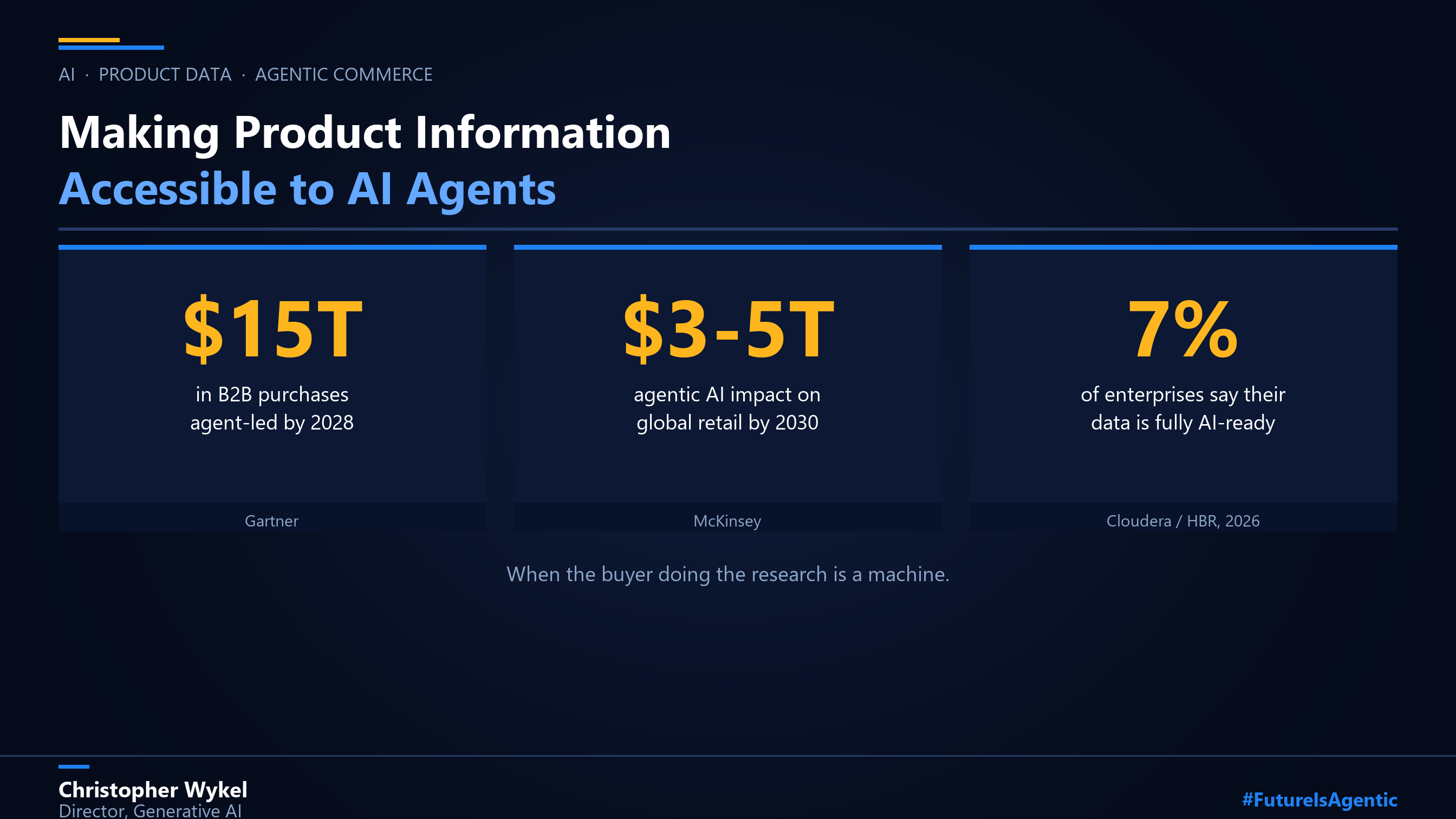
By several credible projections, the entity researching your product in the near future will often not be a person. Gartner estimates that AI agents will intermediate roughly 15 trillion dollars in B2B purchases by 2028; McKinsey puts agentic AI's influence on global retail commerce at 3 to 5 trillion dollars by 2030. And this is not only a forecast: industry surveys in 2026 already report that a majority of B2B buyers use AI assistants somewhere in the purchase process, with a large share beginning their research there. Whatever the precise figures, the direction is not seriously in dispute. A growing share of purchasing decisions will pass through an AI agent before a human finalizes them.
Underneath the forecasts sits a more practical question you may not have examined yet: when an agent does that research, can it actually reach your product information, or not? The answer is what determines whether the shift works for you or passes you by.
An Agent Is Only as Useful as What It Can Reach
An AI agent's value is bounded by what it can reach. A capable model with no access to current, structured information about a product cannot recommend that product with any confidence, however good the model is. When an agent assembles a shortlist of vendors or components, it works from the information it can retrieve and parse. Businesses with reachable and machine-readable product data are in the consideration set. Businesses without are absent from it, not rejected, simply never seen.
For a purchase decision, the information the agent needs to reach is specific: what the product is, what it is compatible with, whether it is in stock, what it costs, and how it compares on the attributes that matter. That information exists inside most companies. The problem is where it lives and what form it takes.
Where Product Information Lives Today
Most product information was structured for human consumption. It often sits in a PIM system behind a human-facing interface, in a digital asset manager or CDN as images and rich media, in PDF spec sheets, in marketplace listings maintained by hand, and in the layout logic of a website designed to be browsed. Each of these serves a person clicking through a catalog well. None of them was built to answer a direct, structured query from an agent.
The result is a mismatch. The data an agent needs is technically present, but it is trapped in formats and interfaces that assume a human is doing the reading. An agent asked to compare three industrial components cannot reliably extract a torque rating from a product photo or a marketing paragraph. If the specification is not exposed in a form it can query, the agent treats it as unknown, and unknown, in a shortlist, usually means excluded.
The data an agent needs is technically present, but it is trapped in formats and interfaces that assume a human is doing the reading.
The Impacts, Specifically
Several things change once product information becomes something an agent can access directly.
Consideration becomes programmatic. The first pass of vendor and product selection increasingly happens without a human present. The agent filters on structured attributes before anyone sees a result, so the completeness and structure of your data determine whether you survive that filter. A gap the agent cannot resolve is not a neutral omission; it is a reason to move to a competitor whose data answered the question.
The first pass of vendor and product selection increasingly happens without a human present.
Data consistency becomes higher-stakes. An agent surfaces exactly what you expose, and it may reach several of your surfaces at once: your site, a distributor's listing, a marketplace entry. Where those disagree, the agent has to resolve the contradiction, and it will often resolve it conservatively, against the vendor whose information it cannot trust. Inconsistency that a human shopper would shrug off becomes a disqualifier.
New paths to conversion open, particularly in B2B and industrial settings. Long purchase cycles stall on exactly the work an agent is good at: confirming compatibility, checking availability, reconciling specifications against a requirement, assembling a compliant order. When an agent can perform those steps against reachable product data, research that used to take a buyer days can resolve in minutes, and steps that used to require a sales conversation can complete on their own. Beyond keeping you in contention, access can shorten the path to a decision.
The interaction moves off your storefront. If an agent completes its research by querying your product data directly and delivers the answer into the buyer's conversation, the buyer may never visit your site. Your front door becomes a data surface, not a page, and on channels you do not own it produces no session, no referral, and no analytics footprint you can see.
If an agent completes its research by querying your product data directly and delivers the answer into the buyer's conversation, the buyer may never visit your site.
The Impact Is Not Automatic
None of this accrues to a business simply because the technology exists. The same year that produced these projections also produced sober warnings. Gartner expects roughly 40 percent of agentic-commerce projects to be canceled by 2027, and MIT research has found that the large majority of generative-AI pilots fail to deliver a return. That does not make agents a mirage. It means the benefit is uneven, accruing to the businesses whose information is ready for an agent to use. By one measure that readiness is rare: in a 2026 study by Cloudera and Harvard Business Review Analytic Services, only 7 percent of enterprises said their data was fully ready for AI. The projections describe the size of the opportunity; they say nothing about who captures it. Readiness does.
The Missing Layer
There is, today, no standard way for a business to take the product information already sitting in its PIM system and its CDN and present it as a surface an agent can query. The data is there. The interface for agents is not. Bridging that gap, by turning existing product information into a structured, current, agent-accessible surface rather than rebuilding it, is the emerging requirement, and the Model Context Protocol is becoming the natural interface for exactly this kind of access.
A surface you build is also a surface you can measure. Because the queries run through infrastructure you control, you can see what agents ask for: how many looked up a given product, what they searched for, which specifications they compared, where they gave up. The visibility that agent-mediated discovery removes on everyone else's channels, you recover on your own, and it arrives as a new and early read on demand. An agent can only recommend what it can read, and product information exposed for machines, not only laid out for people, is the part it can act on. The rest stays invisible to it.
The Work Underneath the Forecasts
None of this requires reinventing the catalog. The product information is already there, in the PIM, the CDN, the spec sheets, the marketplace listings. What it needs is to be exposed in a form a machine can read, kept consistent across every place an agent might look, and maintained as infrastructure rather than marketing collateral. That work is unglamorous and largely invisible to the customer. It is also becoming the thing that determines whether an agent can put a business in front of a buyer at all. The forecasts have settled that agents will do the looking. Each company is responsible for ensuring that, when one looks, there is something it can read.
Sources
- Gartner. Projection: AI agents will intermediate ~$15 trillion in B2B purchases by 2028.
- McKinsey. Estimate: agentic AI will influence $3-5 trillion in global retail commerce by 2030.
- Gartner. Projection: ~40% of agentic-commerce projects will be canceled by 2027.
- MIT (2025). The large majority of generative-AI pilots fail to deliver measurable ROI.
- 2026 B2B buyer-behavior surveys: a majority of B2B buyers now use AI assistants during the purchase process; roughly half begin product research with AI.
- Cloudera and Harvard Business Review Analytic Services, 2026. Only 7% of enterprises say their data is fully ready for AI. cloudera.com